
Bureau County Supervision Types
Probation and state post-prison supervision may begin after a person leaves custody, but they arise from different records. Bureau County probation is imposed by a court and administered through Probation and Court Services. Parole and mandatory supervised release, often called MSR, follow an Illinois prison sentence and are supervised by the Illinois Department of Corrections Parole Division. The Illinois Prisoner Review Board sets conditions and decides specified violation and parole matters.
Do not infer the form of supervision from the place of arrest. Someone booked at Bureau County Jail may receive local probation, transfer to IDOC, or leave without supervision. Likewise, leaving an IDOC prison on MSR is not final discharge from the sentence.
| Supervision | Source | Best public confirmation |
|---|---|---|
| Probation | Bureau County court sentence | Court order, docket, and local probation office |
| Parole | Eligible state prison sentence | IDOC status plus PRB decision records when applicable |
| Mandatory supervised release | Statutory term after a determinate prison sentence | IDOC profile or archived release record |
- Parole
- Conditional community release during a sentence, used for eligible cases.
- Probation
- A court sentence supervised locally instead of, or after a short period of, confinement.
- MSR
- A required supervised term after release from many determinate Illinois prison sentences.
- Discharge
- The formal end of the sentence or supervision, not merely departure from a jail or prison.
Verify Bureau County Supervision
Begin with the system that owns the status. The IDOC Individual in Custody Search includes people currently incarcerated and people currently on parole. A Bureau County criminal case, available through the Judici case search and the Circuit Clerk, is the proper path for probation. Use dates and identifiers to avoid mixing people with similar names.
- Identify whether the sentence came from Bureau County Circuit Court or IDOC. A court probation order and an IDOC parole status are not substitutes.
- For state supervision, search by IDOC number when known. Otherwise, use exact and variant names and compare the profile details.
- For probation, locate the Bureau County case and read the sentencing order and later entries for modification, revocation, termination, or discharge.
- Record the lookup date and exact status. Then contact the office that owns the record if wording or timing is unclear.
- Compare supervision with the actual release record. The full released-person path is covered on the Bureau County released inmates search.
A blank IDOC result is inconclusive. IDOC states that a person who completed the sentence disappears from its live search, though archived records remain available. A blank result might also reflect a name mismatch or no IDOC commitment. Request an archived IDOC record when final discharge must be proven.
The image below comes from the official IDOC search gateway used for current state custody and parole status.
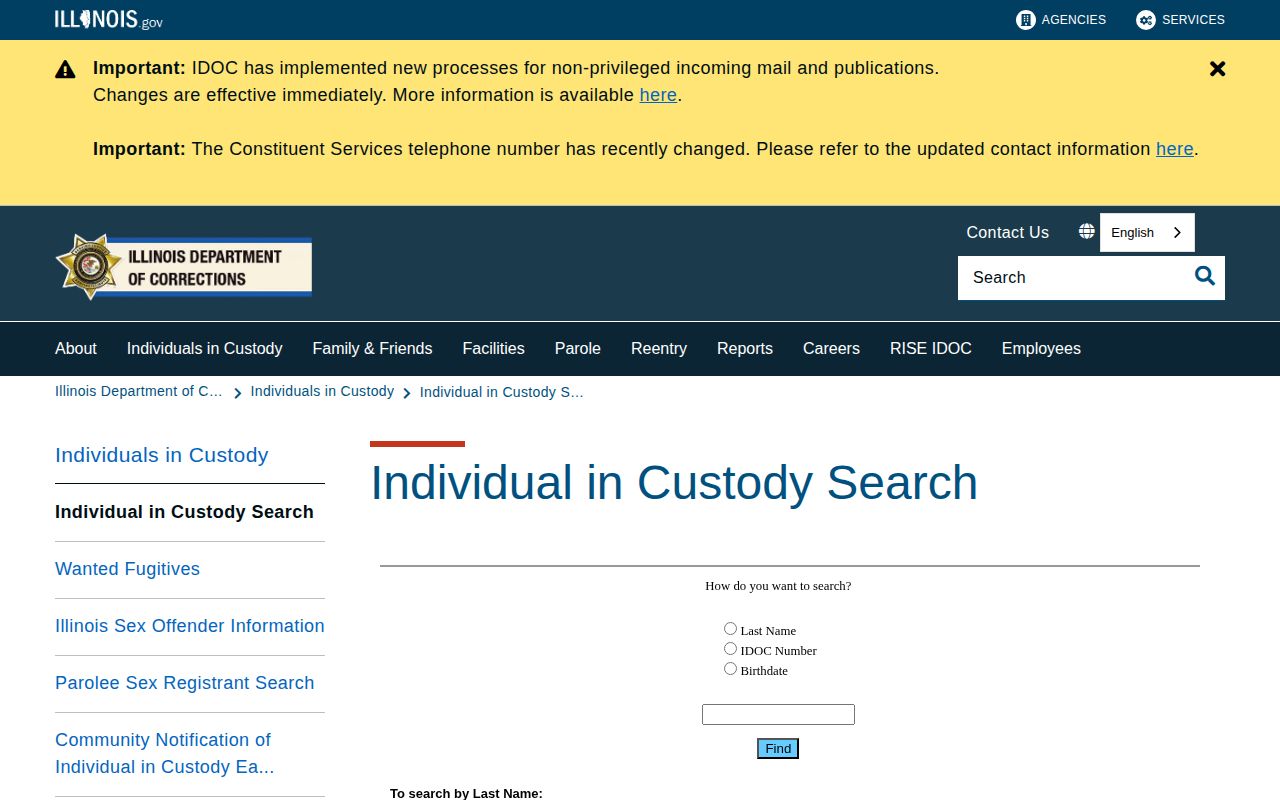
Its live scope is important: it can support a current parole finding, but an archived request is needed for a fully completed sentence.
Bureau County Probation Office
The official Bureau County Probation and Court Services page places local probation within the 13th Judicial Circuit, which also includes Grundy and LaSalle counties. The Bureau office confirms court supervision tied to a Bureau County case. It does not keep IDOC parole records, authenticate a jail door-out time, or serve as a public case-management database.
700 South Main Street, third floor
Princeton, IL 61356
Phone: 815-872-8951
Fax: 815-879-0012
Monday-Friday, 8:00 a.m.-4:30 p.m.
Ask whether a public court order or docket entry reflects active, revoked, modified, or completed probation. Staff may not disclose confidential case-management facts. The Circuit Clerk remains the keeper of the public court record.
The official local office listing shown below documents the Bureau office and its circuit role.
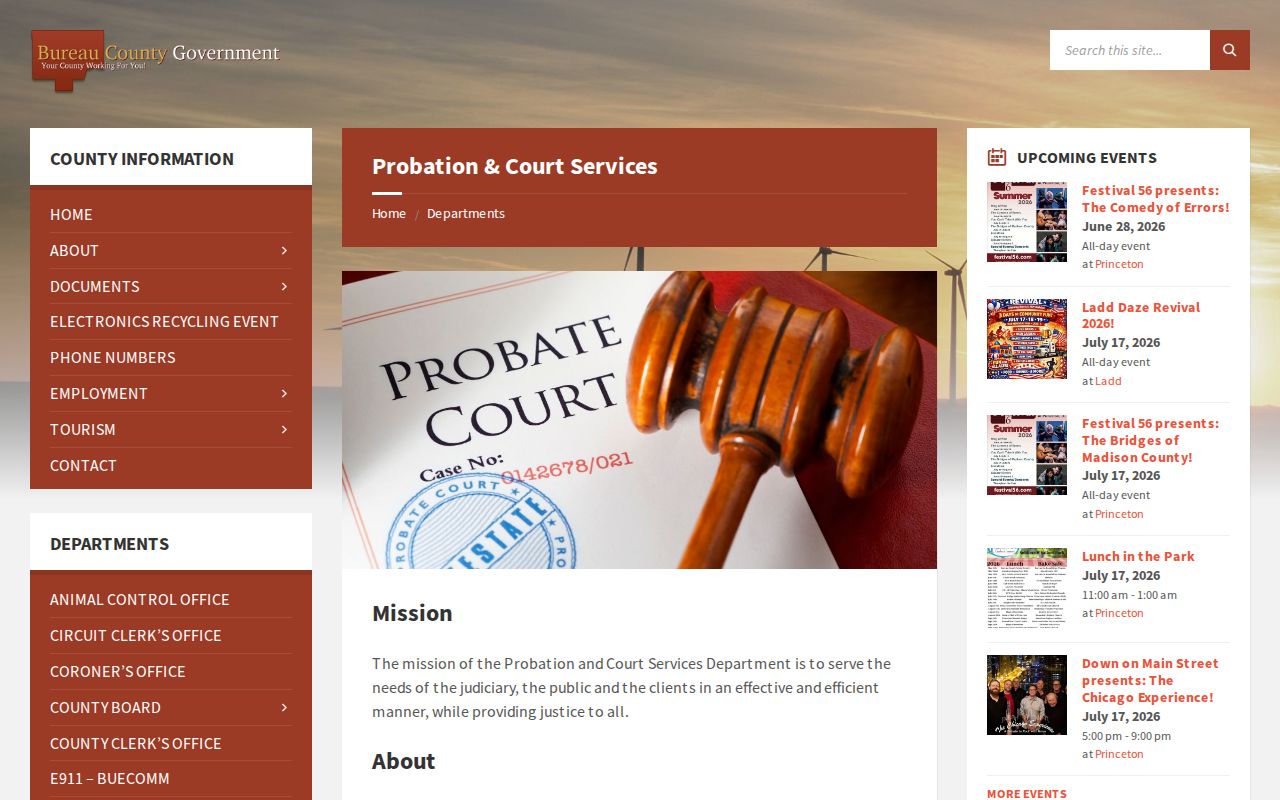
This office is the local route for probation questions, while IDOC remains the route for parole and MSR.
Bureau Supervision Violations
Conditions are rules attached to release or probation. A violation allegation does not mean that the person has already been revoked. For parole or MSR, PRB materials distinguish preliminary findings, revocation hearings, and final results. Final outcomes can return the person to release status, find no violation and resume release after plan approval, or revoke release so IDOC calculates a new date.
For probation, the Bureau County court docket may show a petition, warrant, hearing, modification, revocation, or termination. The court owns that result. A jail record owns any later booking or release event. Keep the two events separate.
An absconder is a person officially reported as having left supervision or failed to report as required. Do not apply that label merely because a person cannot be located. IDOC links a Wanted Fugitives page from its search area, and an official warrant or fugitive entry is needed. VINE may alert on a custody change, but it is not a general list of people missing from supervision.
Check the newest record after any alleged violation. An older profile, hearing schedule, or parole grant may have been overtaken by a return to custody, a new release plan, or a later Board result. The PRB revocation schedule shows matters set for hearing, while the results page records outcomes that have been published. A schedule proves only that a proceeding was listed. It does not prove a violation, revocation, or present custody status.
For a local probation matter, use the court’s latest signed order when wording matters. A docket entry may summarize an event without including every condition or finding. If a warrant led to a Bureau County booking, the Sheriff’s record can establish the custody time, while the court record establishes the legal basis. Keeping those roles distinct prevents a supervision allegation from being reported as a final ruling.
Bureau County Parole Hearings
The PRB yearly en banc schedule lists monthly full-board meeting dates. En banc review applies to indeterminate and certain youthful-parole matters. It is not an ordinary release vote for every modern IDOC sentence. For most determinate sentences after 1978, PRB sets conditions while release follows the required statutory time.
Indeterminate C-number cases concern crimes sentenced under the pre-1978 structure. PRB says review begins after the IDOC-calculated minimum, with later interviews generally set one to five years apart. The Board may grant or deny parole by majority vote. Youthful-parole review has distinct eligibility rules under 730 ILCS 5/5-4.5-115, so age, offense, sentence, exclusions, and effective date must all be checked.
The image below links to the official yearly en banc calendar.
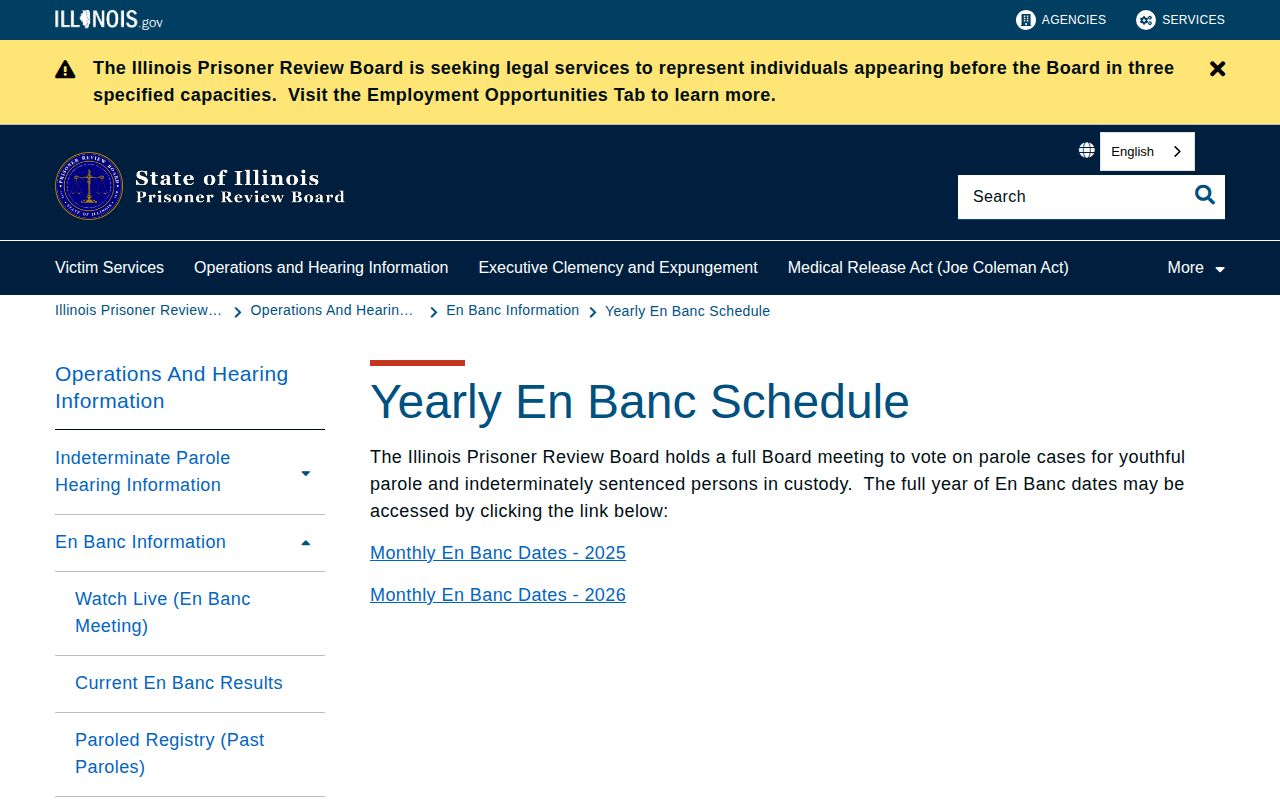
Use a current agenda or result with the IDOC profile. An omitted name proves neither denial nor discharge.
Bureau Jail H.O.P.E. Program
The Bureau County Jail describes H.O.P.E., Helping Others by Providing Education. Community partners provide chemical-dependency education, life skills and well-being work, GED support, religious programs, and other preparation inside the jail.
H.O.P.E. is not a public released-person locator. Participation does not prove that a person received probation, entered parole, or has access to a specific post-release service. Verify supervision through the court or IDOC. The program is useful context for release preparation, but it cannot replace an official status record.
Correct Bureau Supervision Records
IDOC Field Services records add detail that a live profile may not show. The Field Services directive says the master file tracks release date and type, warrant status, discharge processing, and available official identity documents in pre-release material. Ask IDOC to correct the exact field or document it owns.
A different route applies to a state criminal-history transcript. The Illinois State Police Access and Review process handles review or challenge of that record. It does not edit a Bureau County court order, Sheriff jail ledger, PRB decision, or IDOC event. Preserve the disputed label, source, identifier, and lookup time before seeking a correction.
Bureau County Supervision Discharge
Supervision ends through a formal agency or court event. Probation may end by a Bureau County order showing termination or discharge. State parole or MSR ends through IDOC and PRB processes reflected in the releasee file and final-discharge record. Leaving prison is an earlier event and should not be called final discharge.
Illinois FOIA, 5 ILCS 140, provides a route to request nonexempt public records. Ask for the smallest set that proves the event: actual release date and type, start of parole or MSR, warrant or return entries if relevant, and final discharge. A current IDOC no-result cannot prove completion because the live search also omits people who were never committed to IDOC or whose identifying data was entered differently.
For probation, obtain the public sentencing order and later docket entries from the Bureau County Circuit Clerk. For parole or MSR, use IDOC records and the relevant PRB revocation results. This event-by-event method shows whether supervision remains active, changed, or formally ended.
A focused archived request should identify the person by full name, birth date, IDOC number, year received, facility, county of conviction, and approximate dates when those facts are known. Ask for records sufficient to show admission, actual release date and type, the start of parole or MSR, any return or warrant event relevant to the question, and final discharge. That phrasing seeks discrete agency facts. It avoids treating the entire field file as public or assuming that a missing live profile means the sentence ended.
The court record and IDOC archive serve different purposes. A Bureau County sentencing order establishes the sentence the judge imposed. IDOC records later administrative events, including release from prison and discharge processing. PRB materials may corroborate a grant, revocation, or final-discharge decision within the Board’s authority. Match the same IDOC number and dates across the sources before reaching a conclusion. If the records conflict, preserve each exact label and lookup date, then ask the office that owns that field to review it.
Public Record Search
Sponsored Results