
Record Bureau County Date Labels
Write down the date label exactly as the official source displays it. Also record the person’s identifier, custody status, facility, holding offense, sentence structure, and lookup time. Those details make later changes understandable. A projected parole date can move after an earned-credit adjustment, while an MSR date describes a supervised stage and a discharge date describes the end of the sentence. If two records conflict, compare the event each office owns before asking for a correction. A Sheriff timestamp, court order, IDOC calculation, and PRB decision can all be accurate while describing different steps.
Start With Bureau County Custody
A reliable projected release date begins with the sentence and the agency doing the calculation. Bureau County Jail holds people before trial and people serving local terms, while IDOC calculates dates for state-prison sentences. The Bureau County court file supplies the order that created the term, but the court docket does not replace the custodian’s operational calculation. Check the signed judgment for sentence length, presentence custody credit, whether terms run at the same time or one after another, and any later order that changes those terms.
For someone awaiting trial, the useful event is usually a detention or pretrial-release order rather than a sentence-end date. Even after a judge authorizes release, the Sheriff must receive the order, check warrants and detainers, complete the jail record, and determine whether another agency will take custody. Ask for the actual discharge or transfer entry after processing. If that entry names IDOC, another county, federal authorities, or immigration custody, the person left Bureau County Jail but did not necessarily return to the community.
A state-prison calculation needs a second layer of care. IDOC’s future date reflects the sentence and credits in its system at the time of lookup. The Illinois Prisoner Review Board may set release conditions or decide a revocation matter, but it does not conduct an ordinary discretionary parole vote for every modern determinate sentence. A PRB revocation can return a person to custody, after which IDOC calculates a new date. Read the current IDOC profile alongside any relevant PRB decision rather than relying on an old projected date.
Bureau County Release Date Types
A projected, scheduled, tentative, parole, mandatory supervised release, and final discharge date can mark different points. The projected date is the agency’s present calculation. Actual release is the event recorded when a custodian lets a person leave or transfers that person elsewhere. Mandatory supervised release, often shortened to MSR, is time in the community under IDOC supervision after prison. Final discharge ends the sentence and supervision. None of those labels should be silently changed into another.
A Bureau County Jail detainee awaiting trial usually has no computed sentence-end date. A judge may enter a pretrial-release order, but the order date does not prove the moment the jail completed release. A sentenced person may have a term and credit calculation. If the sentence is more than one year, county sources say the person transfers to IDOC, so the county departure is not a community release.
Find a Bureau County Release Date
Start with the last known custodian. The Bureau County Jail and IDOC maintain different records, and the Circuit Clerk maintains the sentence or release order. A blank live roster or search result is not proof that release occurred. Use identifiers such as a booking number, case number, IDOC number, date of birth, and known name variants to avoid matching the wrong person.
- Check the Bureau County criminal case through the Circuit Clerk or Judici. Read the signed order, sentence, jail-credit entry, and any mittimus, which is the commitment order.
- For a county-jail term, ask Sheriff’s Records for the sentence calculation, jail ledger entries, projected completion, and any hold or transfer notation.
- For a prison term, use the IDOC Individual in Custody Search. Search by IDOC number when known, then try name and birth-date fields.
- Open the matching profile and copy the exact label, date, status, location, holding offenses, and lookup time. Do not rename an MSR or parole date as final discharge.
- After the expected date, obtain the custodian’s actual release date and type. If an IDOC profile disappears after sentence completion, request an archived record.
The broader Bureau County released inmate search helps distinguish a county release, an IDOC transfer, and another custodian. That distinction prevents a gap between the county roster and IDOC intake from being mistaken for freedom.
IDOC Bureau County Date Fields
IDOC says its live search covers people currently incarcerated or on parole. A profile may show admission, sentence, location or status, and parole, MSR, projected, or release-related information based on sentence type. The interface supports surname, IDOC number, and birth-date searches. A completed sentence can cause the person to vanish from the live system, while the underlying record remains available through an archive search.
The official IDOC search form shows the fields used to start a state record lookup.
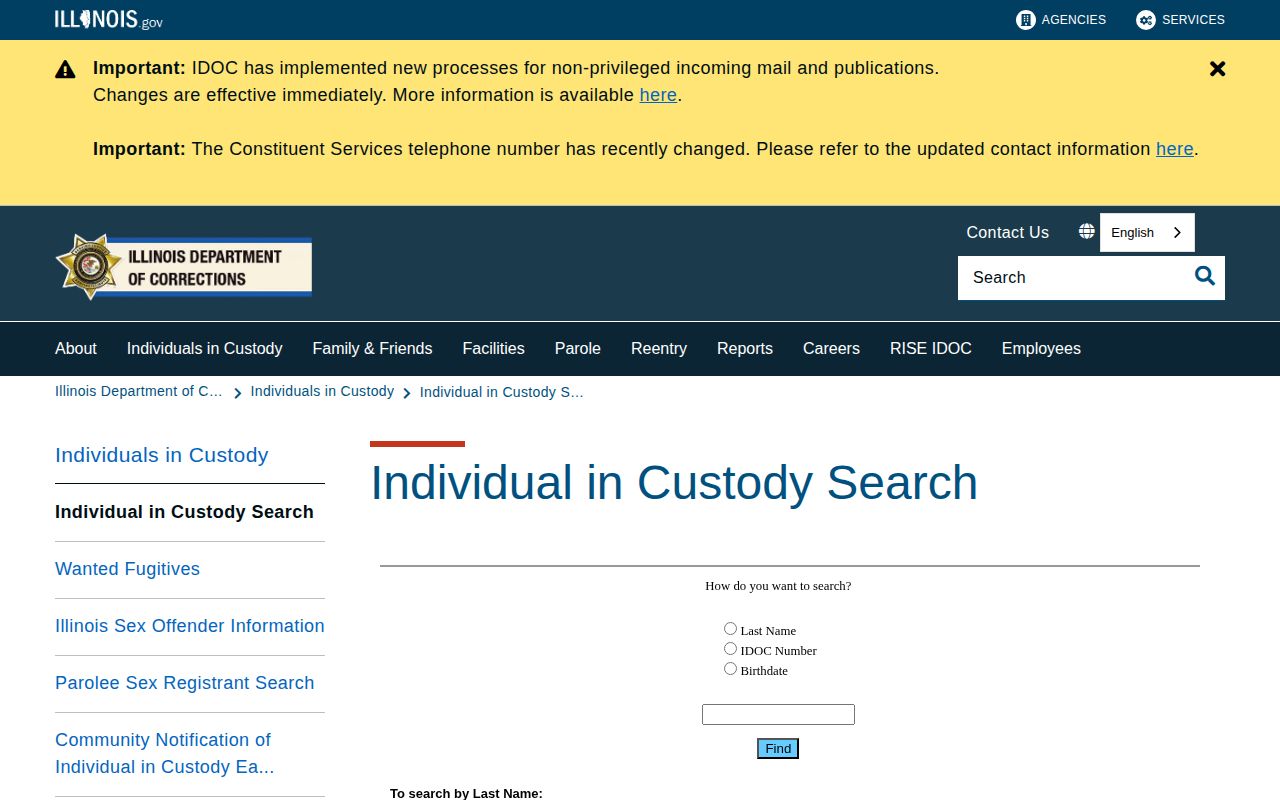
The form is the state route for a Bureau County case that led to prison, not for a person serving a short county-jail sentence.
| Profile item | How to read it |
|---|---|
| Status or location | Identifies the current IDOC state, including incarceration or parole when displayed. |
| Admission and sentence | Helps match the person and connect the profile to the court judgment. |
| Projected or parole label | Records the agency’s current future-date calculation, not a completed release. |
| MSR information | Concerns supervised release after prison and differs from final discharge. |
| No live result | May mean a mismatch, no IDOC commitment, or a completed sentence that requires an archive request. |
Illinois Release Credit Rules
Illinois sentence credit is governed by 730 ILCS 5/3-6-3. The law addresses credit for conduct and specified programs, exclusions, discretionary awards, and minimum service rules. It also sets truth-in-sentencing floors for listed offenses. Some listed offenses require service of 85 percent, other categories use 75 or 100 percent, and special floors may apply. “Everyone serves 85 percent” is not a valid Illinois formula.
The calculation depends on the offense, date, statutory subsection, sentence structure, presentence custody credit, and awards or revocations. The statute describes some added earned credit only after at least 60 days served, including county-jail time, but eligibility is not an award. IDOC says it cannot predict whether or when a named person will receive discretionary credit. When Earned Sentence Credit changes a revised parole date, IDOC says the adjustment should appear in the profile.
- Sentence credit
- Time applied under law against the term being served.
- Presentence credit
- Eligible custody time credited by the court for time before sentencing.
- Consecutive sentence
- A term that follows another term rather than running at the same time.
- MSR
- Mandatory supervised release after leaving an Illinois prison.
Bureau County Jail Calculations
Bureau County’s official sources describe the jail as holding people awaiting trial and people serving county terms of up to 364 days. They do not publish a local good-time formula or an online projected-date calculator. Applying an IDOC profile date to a county term would therefore be wrong. The needed records are the judge’s sentencing order, jail-credit findings, and the Sheriff’s own computation.
Ask Sheriff’s Records for the calculation sheet or jail-ledger entries that support the projected completion date. The request should also seek the policy or statute used, any credit applied, and any hold or transfer entry. The Circuit Clerk can supply the public sentence and later orders, but a court date alone may not show the exact time a person left 800 Ace Road.
Note: Bureau County publishes no local jail release-date calculator, so a case-specific Sheriff record is essential.
Why Bureau County Dates Change
A release calculation is a moving administrative result. New legal events, credit decisions, and custody holds can change it. Compare the date over time and preserve the exact label rather than relying on a remembered screenshot.
| Factor | Possible effect | Best record |
|---|---|---|
| Earned credit | May advance the revised date after an award. | IDOC profile and credit record |
| Discipline or escape time | May revoke credit or exclude time. | Custodian calculation record |
| Concurrent or consecutive terms | Changes how multiple sentences combine. | Judgment and IDOC calculation |
| Detainer or warrant | May cause transfer to another custodian rather than community release. | Sheriff or IDOC hold entry |
| New or corrected court order | May change credit, sentence, or legal authority. | Bureau County court order |
| Parole or MSR revocation | Can return a person to custody and produce a new date. | PRB result and IDOC record |
A detainer is another agency’s request to hold or notify about a person. It can mean the person leaves Bureau County or IDOC custody but enters another system. The first custodian’s “release” entry must be read with its destination.
Archive a Bureau County Discharge
IDOC’s live-search boundary is vital for a completed sentence. Its FAQ says a person who has completed the sentence is no longer shown in the public search. The state’s Field Services directive says the master-file face sheet records release date and type, while later processing records final discharge. A narrow archive request can seek admission, actual release and type, start of parole or MSR, final discharge, and the records supporting those dates.
The IDOC FAQ explains the live-search and archived-record split.
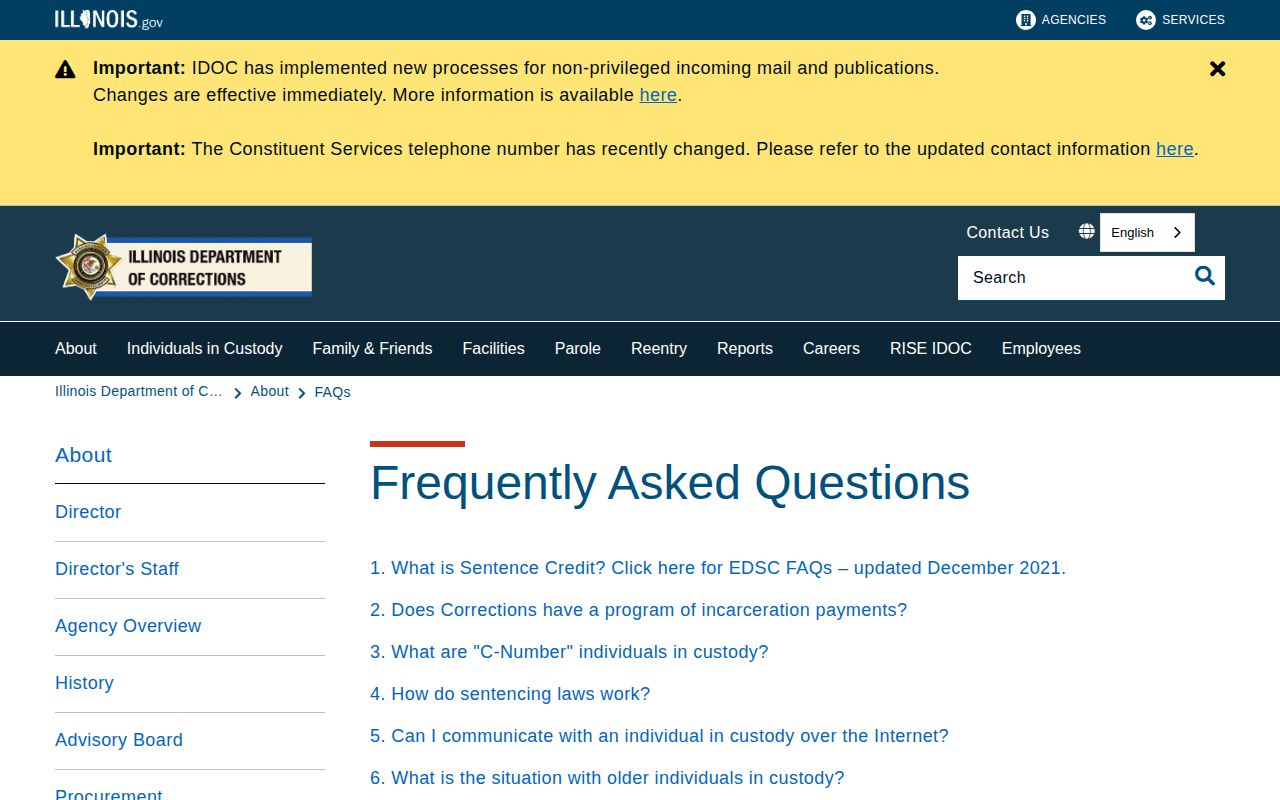
This archive route turns a missing live profile into a records question instead of an unsupported discharge claim.
Confirm Bureau County Actual Release
Once the projected day arrives, check the event with the agency that held the person. For Bureau County Jail, request the discharge or transfer timestamp, event type, destination, and releasing authority. Pair it with the court order when the legal reason matters. For IDOC, read the new status and obtain the release or archived record if final proof is needed.
Illinois VINE can send a pending custody-change alert when registration is available, but it relays source data and is not the official record keeper. A transfer, escape, death, or out-to-court alert is not the same as community release. The VINE Inmate Check explains how to identify the source and register before the event. Record the alert time, then confirm it with the Sheriff or IDOC.
Keep a short comparison record when dates conflict. Note the source, exact label, identifier, event date, lookup date, and whether the entry describes release, transfer, parole, MSR, or discharge. Ask each agency to correct only the event it owns. The Sheriff owns county custody entries, the court owns its orders, IDOC owns state calculations and discharge records, and the Prisoner Review Board owns its decisions. A record can be right about one stage yet silent about the next.
Federal and immigration dates require separate systems. BOP dates concern federal custody, while ICE’s locator concerns present immigration detention. Neither can establish a Bureau County jail release by itself. The final answer always comes from the custodian that owns the specific transition.